
Fantasy Cricket on Hero11: The Rules That Shape Every Squad
Before tactics, the constraints. The credit budget, the per-side cap and the role minimums decide what a squad can even look like, and the lock time decides when thinking stops.
18+ only · Skill-based fantasy · Android 7.0+ · 3.14 MB file
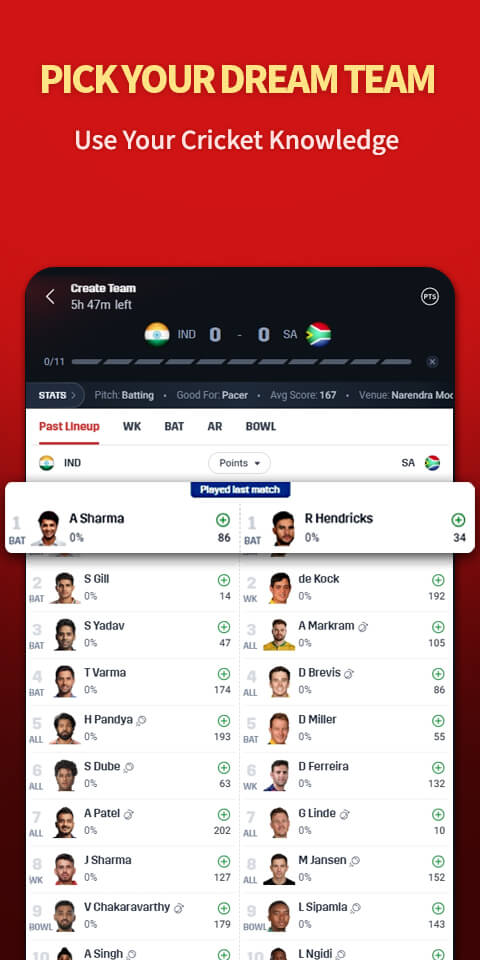
The constraints, in the order they bite
A fantasy squad is not a wish list. Four rules narrow the field before judgement enters, and understanding them turns selection from guesswork into a trade-off you can reason about.
| Rule | What it means in practice |
|---|---|
| Credit budget | Every player costs credits and the squad has a ceiling. Three premium picks usually force four cheap ones. |
| Players per side | You cannot fill the squad from the stronger team. The cap forces at least a few picks from the other side. |
| Role minimums | Batters, bowlers, all-rounders and a wicket-keeper each have a minimum count. |
| Captain and vice-captain | Two nominated players score at a multiplier. They are the two picks that move a total most. |
| Lock time | Editing stops at the toss. After that the squad is fixed for that contest. |
The practical effect is that every premium pick is paid for by a cheaper one somewhere else. The interesting question is never “is this player good” but “is he worth what he costs me elsewhere in the squad”.
What actually earns points
Scoring rewards involvement. A player who bats ten balls and fields quietly contributes almost nothing, however famous he is. A bowler who sends down four overs in a T20 has four chances at a wicket, a maiden and an economy bonus.
- Top-order batters are valuable because they are guaranteed to bat, and bat longest.
- Frontline bowlers are valuable because a full quota is a lot of chances.
- All-rounders score in two columns, which is why they are usually expensive.
- Wicket-keepers pick up fielding points nobody else can.
- Lower-order finishers are a gamble: huge if the innings reaches them, nothing if it does not.

The points page goes through each category and how to read the sheet inside the app.
Formats change the answer
| Format | What swings the contest | Selection bias |
|---|---|---|
| T20 | A few overs and one big over | Death bowlers and top-order batters; variance is high |
| One-day | Long innings and full bowling quotas | Consistency; set batters and frontline bowlers |
| Longer formats | Sessions rather than overs | Players guaranteed a long involvement over several days |
| Women's fixtures | Same scoring, different depth of data | Team news matters even more because rotations are larger |
A T20 contest is a short, noisy sample, so a single over can decide it. That is an argument for accepting variance in small contests and for not reading too much into one result.
Lock time and team news
- Draft a squad early so you are not rushing, but expect to change it.
- Watch for the team sheet, which usually lands close to the toss.
- Remove anyone not in the eleven. A player who does not play scores nothing at all.
- Reconsider the captain once you know the conditions and who is actually bowling.
- Confirm before the lock. The clock in the app governs, not the broadcast.
Next: build a first team step by step, or compare contest shapes to decide where to enter it.
Fantasy cricket questions
How many players come from each team?
The builder sets a cap on players from one side, so a squad drawn entirely from the favourite will not save. The cap is shown while you pick.
Do I have to use the whole credit budget?
No, but leaving credits unspent is usually wasteful. The budget exists to force a trade-off, not to be saved.
What happens if a match is abandoned?
The app applies its own rule for the fixture, usually cancelling the contest and returning entries. The contest card states the rule before you join.
Can I edit a team after joining?
Yes, until the lock at the toss. After that the squad is fixed for that contest, even if a player is withdrawn.
Is one team enough?
For head-to-head and small leagues, usually. Large fields reward several differentiated teams, but each one costs another entry fee.
Join a Hero11 contest
The contest button opens the fantasy lobby in any mobile browser. The download button opens the promo page for the Android file.
18+ only · v1.13.f675 · Android 7.0+ · Paid contests excluded in Andhra Pradesh, Assam, Odisha, Telangana, Nagaland and Sikkim
Why the constraints are the interesting part
New players treat the credit budget as an obstacle between them and the squad they want. It is the opposite: it is the mechanism that turns selection into a question with an answer.
Without a budget, everyone picks the eleven best players and the contest is decided by luck alone. With one, every pick becomes a comparison — this player against the two cheaper ones his price forces you to drop. That comparison is answerable with public information, which is why the format rewards work at all.
It follows that a squad you cannot justify slot by slot is not a squad, it is a shortlist that happened to fit. The test before confirming is simple: for each expensive player, name the cheaper one you dropped to afford him. If you cannot, the builder made that decision rather than you.
What a fantasy contest is not
- Not a prediction of the result. Your squad can draw entirely from the losing side and still win a contest.
- Not a bet on an outcome. Nothing you select resolves against the match result; it resolves against individual involvement.
- Not an investment. An entry fee is spent at the moment you confirm. In a large field most entries return nothing.
- Not improved by watching. After the lock you are a spectator; a live rank changes nothing and costs an afternoon.